Tax-Saving Donation
Every March, many of us scramble to organise our tax-saving investments before the financial year closes. Insurance premiums, PPF deposits, ELSS funds: the usual set. But there is one provision in the Income Tax Act that most people overlook, one that does not just reduce your tax outgo but does something more lasting: it keeps a child in school.
If you want to save tax by donating to an NGO in India, Section 80G of the Income Tax Act is your route. And if you want that donation to mean something beyond a receipt, a charity donation for children’s education in India, specifically for the children in government schools who are at the highest risk of falling behind, is where it goes furthest.
At Peepul, we are a 12A and 80G registered non-profit working on foundational learning in government schools. Your donation qualifies for a tax deduction. And what it funds: in classrooms, in teachers’ hands, in children’s reading and writing, is very real.
The Link Between Your Rupee and a Child’s Classroom
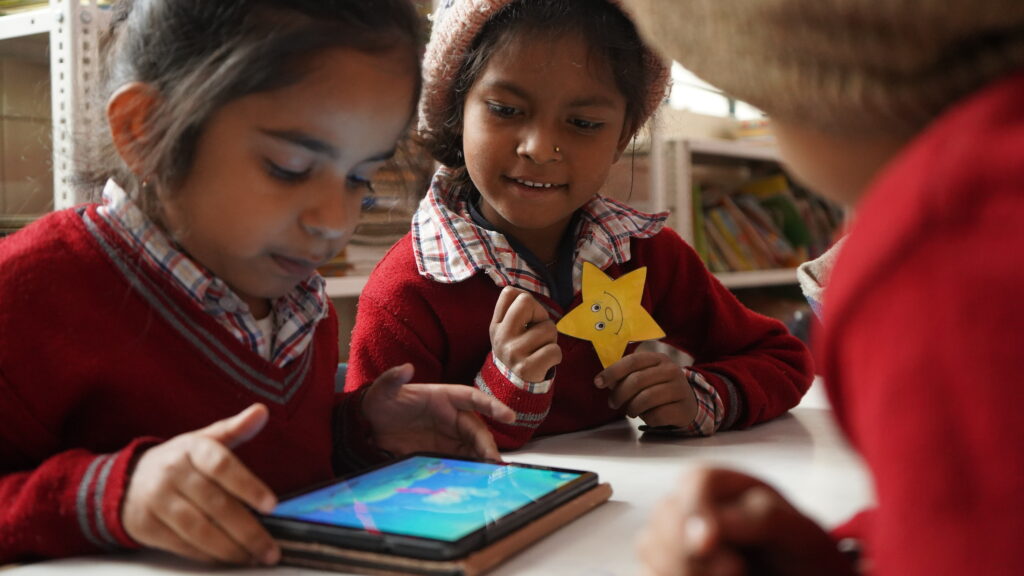
When you donate to support government school education through Peepul, your contribution goes into programmes that work directly inside government schools in India. We do not build parallel systems. We work with what already exists. The school, the teacher, the system, and we make it work better for children who are at risk of falling behind or dropping out.
We train teachers in pedagogically sound methods. We co-create print-rich, high-engagement classrooms. We introduce structured teaching resources aligned with foundational literacy and numeracy (FLN) goals. We work with the education system, not around it, so that the impact sticks long after our involvement.
The result: children who attend school regularly, learn at grade level, do not fall behind, and step into higher classes with confidence.
None of this is possible, however, if the child is not in school. Attendance is not a bureaucratic metric for us. It is the starting point of everything.

Mark Your Attendance: What the Campaign Means
We have all been students once. We remember the register being called, our name being read out, and the act of saying present. That word ”present” carried a weight of commitment. You were there.
Our ongoing campaign, Mark Your Attendance, borrows from that memory and asks something of you now, as an adult with the means to show up for a child who needs you.
The campaign runs across February and March, a period when school attendance is crucial for children approaching the end of their academic year, and a period when Indian taxpayers are making their final tax-saving decisions before 31 March.
The two align perfectly.
Tax season is ending. Their opportunity is just beginning. Mark your attendance. Donate.
When you donate to Peepul India before 31 March, you claim your 80G deduction and, at the same time, help children in government schools with learning resources to stay, learn, and grow.
What Is Section 80G and How Does It Work for You?
Understanding the NGO tax benefit under Section 80G is straightforward once you know the structure. Section 80G of the Income Tax Act, 1961, allows donors to claim a tax deduction on amounts donated to registered charitable organisations. An NGO donation with tax exemption in India works by reducing your taxable income, not by giving you cash back directly, but by lowering the income on which your tax-saving is calculated.
Peepul India holds valid 12A and 80G registrations. Your 80G donation for an education NGO like ours qualifies under this provision.
Here is the basic structure:
Who can donate and claim: Resident individuals, salaried employees, self-employed professionals, companies, HUFs (Hindu Undivided Families), and NRIs who donate to eligible Indian institutions.
How much deduction can you claim: For most registered NGOs, including Peepul India, donors receive a 50% deduction on the donated amount.
So if you donate ₹10,000, ₹5,000 is deducted from your taxable income. If you are in the 30% tax-savingbracket, that means ₹1,500 back in your pocket, and a child’s school resources are funded.
Important conditions:
- Donations must be made via banking channels: cheque, NEFT, UPI, or demand draft.
- You must collect a valid donation receipt (Form 10BE) bearing Peepul India’s 80G registration number.
- You must be filing under the old tax regime. The 80G deduction is not available under the new tax regime (Section 115BAC).
- Declare the deduction under Schedule 80G while filing your Income Tax Return (ITR).
For corporate donors: Companies filing CSR contributions as donations to an education NGO in India can also explore 80G benefits alongside CSR compliance. Consult your tax-saving advisor for the applicable structure.
The Learning Outcomes Your Donation Supports
Here is what actually changes on the ground when you donate for child education in India through Peepul India.
1. Teachers Who Know How to Teach Reading
A child in Class 2 who cannot read a simple sentence is not a failing child. In most cases, the child has simply not been taught with the right approach. Peepul India trains teachers in structured, evidence-backed methods for foundational literacy, the skill of reading. We equip teachers with materials, build their capacity through ongoing coaching, and help them track where each child is and what they need next.
This is the foundation of FLN (Foundational Literacy and Numeracy), the national priority under the National Education Policy 2020 and the NIPUN Bharat mission. We have been doing this work long before it became a national headline.
2. Classrooms That Invite Children to Learn
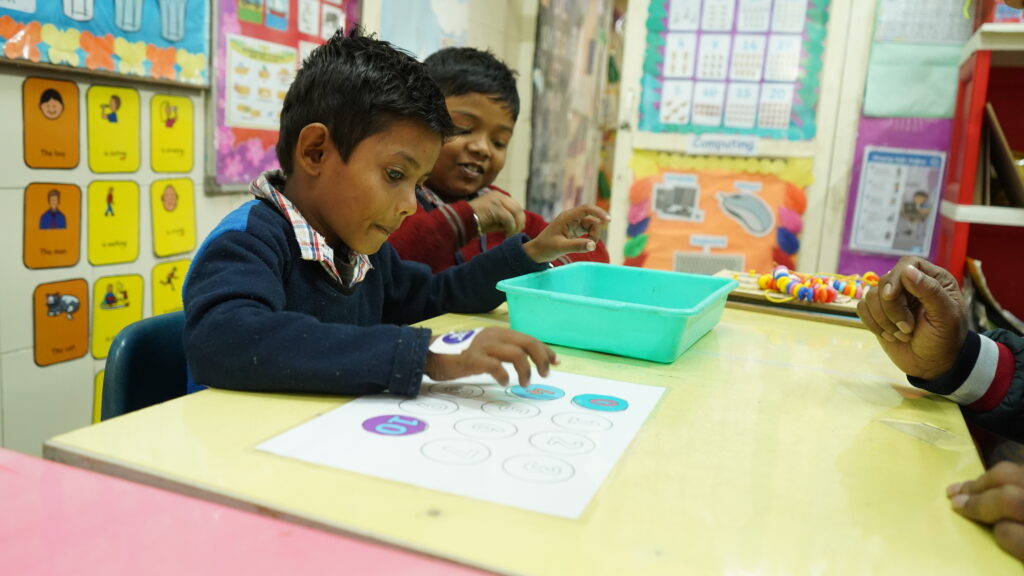
We co-create print-rich environments. Walls with letters, words, numbers, stories. Classrooms where something is always there for a child to look at, touch, or read. It is deliberate learning design. Research consistently shows that environment matters in early learning. When children walk into a room that respects them as learners, they stay. They engage. They come back.
3. Tracking Progress, Not Just Presence
We measure learning outcomes, not with distant assessments, but with tools that teachers use in the classroom regularly, to understand whether a child is learning to read, to count, to comprehend. When a child is falling behind, we know early. When interventions work, we know why. This is how the learning cascade stays connected. From your donation to a teacher’s hand to a child’s reading aloud for the first time.
4. Parent and Family Engagement
A child’s learning journey does not end at the school gate. Our work includes engaging families, helping parents understand how to support learning at home, how to talk about school, and how to send their child to school every day. Many of our most powerful stories come from families who came back to school after dropping out, who chose to stay enrolled through hardship, who saw their child become a reader and decided that school was worth protecting.
Why Attendance Is the Hinge
All of the above, teacher training, learning materials, classroom design, outcome tracking, depend on one thing: the child being in school.
School dropout in India is not a sudden event. It is a slow withdrawal. A child misses a week because of illness. Then another week for a wedding. Then stops coming altogether because falling behind feels too hard to fix. Families, particularly in economically vulnerable communities, make impossible calculations daily: should the child earn today, or learn today?
When you donate to Peepul, your contribution supports the full ecosystem that makes attendance feel safe and worthwhile. A school where a child feels seen by their teacher. A classroom where learning is possible. A family that is told: ” Your child’s education matters. The school bell is ringing for them. Come back.
This is why our campaign asks you to mark your attendance, because by showing up as a donor, you give a child the chance to show up as a learner.
Don’t Just Save Tax. Save a Seat in a Classroom.
The financial year ends on 31 March. For millions of Indian taxpayers, this is a deadline of spreadsheets and receipts and last-minute investments.
For the children Peepul works with, March is something else. The final stretch of a school year. A child sitting in a classroom who almost dropped out. A teacher using tools they learned in a Peepul training last month. A parent who came back to the school after a long absence to ask: ” How is my child doing”?
You can be part of that story. Not as a distant funder, but as someone who marked their attendance. Who showed up, chose to be present, and backed a child’s right to learn.
Donate to Peepul India before 31 March. Claim your 80G deduction. And help a child stay in school.
FAQs
- Can I donate and claim 80G before 31 March?
Yes. Donations made before 31 March of the current financial year qualify for an 80G deduction in that year’s ITR. This is why our Mark Your Attendance campaign runs through the end of the financial year. It is your last window to tax-saving and fund a child’s learning.
- Can a company donate to Peepul India for CSR and claim 80G?
Companies can donate to Peepul. The intersection of 80G and CSR compliance varies by structure. We recommend consulting your CA or tax-saving advisor to determine the right approach for your company.
- What is FLN, and why does it matter?
Foundational Literacy and Numeracy (FLN) refers to the basic competencies of reading with comprehension and performing basic arithmetic that every child should achieve by Class 3. India’s NIPUN Bharat mission (2021) set a national goal to achieve universal FLN by 2026-27. Without these foundations, children are unable to keep pace with higher classes and are at significantly greater risk of school dropout.
- Is Peepuls 80G registration valid for FY 2024-25?
Yes. You can verify Peepul’s 80G registration status on the Income Tax Department’s e-filing portal at incometaxindia.gov.in by searching our PAN or registration number. You can also write to us directly at contact@peepulindia.org for confirmation.
- What is Form 10BE, and why do I need it?
Form 10BE is the official donation certificate issued by a registered NGO to the donor, introduced after Budget 2021 as the required document for claiming 80G deductions while filing ITR. It contains a Donation Reference Number (DRN). Peepul issues Form 10BE to all donors.
This blog post is intended for general informational purposes regarding Section 80G of the Income Tax Act, 1961. For personalised tax-saving advice, please consult a certified Chartered Accountant. Peepuls 80G registration details are available on request and can be verified on the Income Tax Department’s e-filing portal.be verified on the Income Tax Department’s e-filing portal.