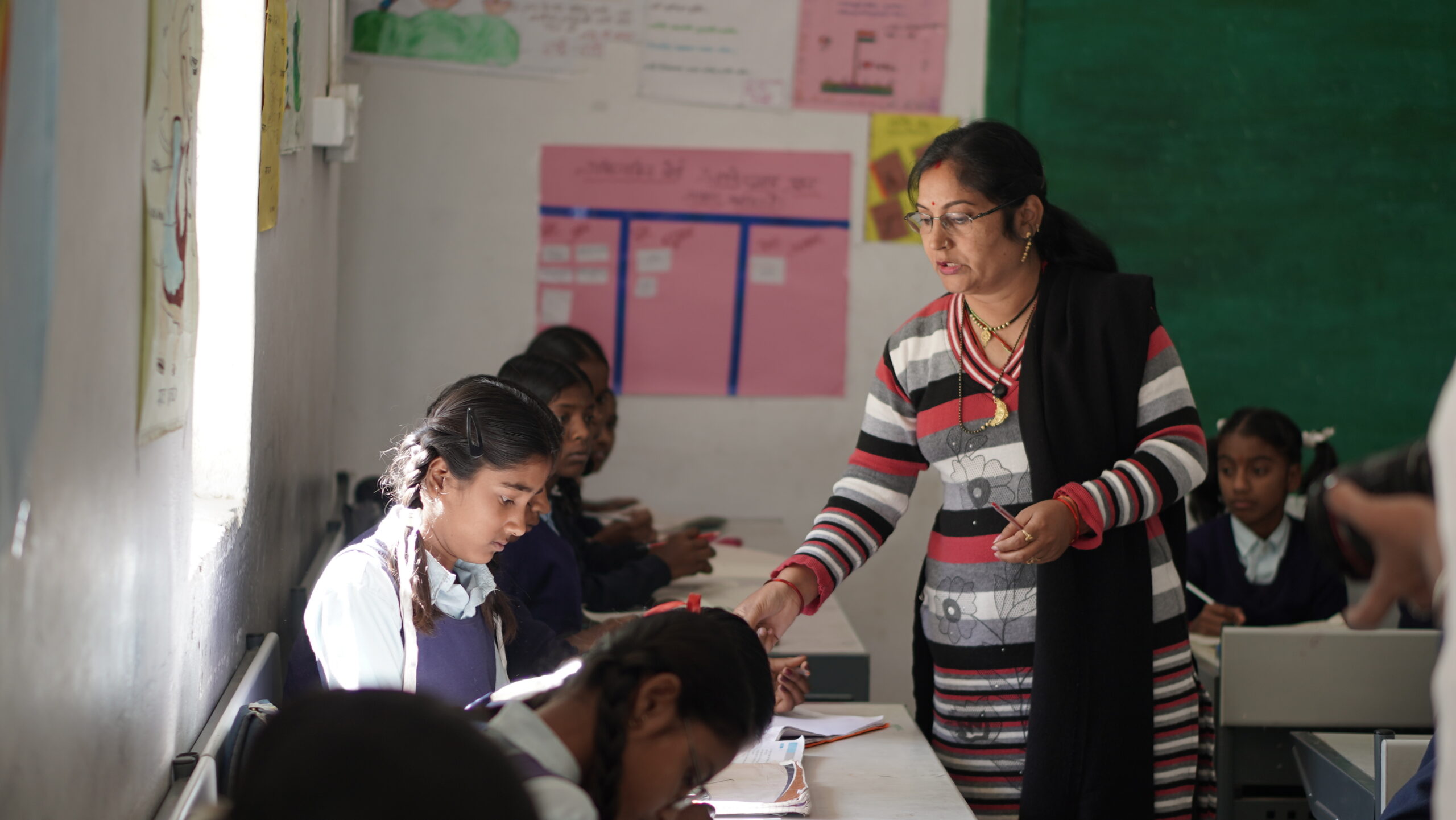
Improving learning outcomes at scale begins with great teaching. But great teaching does not happen in isolation. Teacher support, the leadership they experience, and the systems that enable them to continuously strengthen their practice shape it.
Across India, governments are investing significantly to improve education quality, recognising that better learning outcomes depend not only on curriculum and infrastructure, but also on the people who bring classrooms to life every day. Teacher professional development has therefore become a central pillar of education reform.
Teachers Are the Frontline, But They Are Not AloneTeachers Are the Frontline, But They Are Not Alone
The disruption caused by the pandemic highlighted the extraordinary commitment of teachers across India. Despite unprecedented challenges, they remained the most consistent point of connection between schools and students, ensuring that learning continued wherever possible.
The experience also reinforced an important lesson: teachers achieve the greatest impact when they receive continuous, structured professional support rather than isolated training sessions.
This understanding has shaped the evolution of teacher professional development across many government education systems. Increasingly, professional learning is being designed as an ongoing journey that combines structured learning opportunities with classroom application, mentoring and regular feedback.
The need for this approach is clear. More than 100 million children in India are in the foundational learning years, making the quality of classroom teaching one of the most important determinants of future learning outcomes. National evidence, including findings from the ASER 2024 report, suggests that while teacher training is essential, sustained improvements are more likely when teachers continue to receive support as they implement new practices in their classrooms.
What Teacher Professional Development Looks Like When It Works
Effective training follows a full arc, not a single session:
Pre-work – a short hook that gets a teacher thinking about the topic before the session begins
Course session – the core training, breaking down one concept clearly and linking it to real classroom situations
Post-work – applying what was learned and checking for understanding
This structure repeats through a cascaded model: subject resource groups are trained first; they train master trainers, and master trainers train teachers at the block level. This teacher capacity building at Peepul is designed to scale without diluting quality at each step.
Academic Leadership in Schools: The Missing Layer
A teacher who receives excellent training but returns to a school with no follow-up support will lose most of those gains within a term. This is where academic leadership in schools becomes decisive. A Head of School who conducts a genuine classroom observation, watching for more than ten minutes, filling out an independent checklist, and giving specific, constructive feedback, changes what a teacher does the next day in ways a training session alone cannot.
Structured data discussion meetings between a Head of School and teachers, where assessment results are reviewed grade by grade and next steps are agreed on, turn data from a reporting exercise into an instructional tool. This is school leadership development in its most practical form.
The Academic Cadre: DDEs, School Inspectors, SRGs, and Mentors
Beyond the classroom and the Head of School sits a wider layer of government school teachers‘ support system:
District Deputy Directors of Education (DDEs) and School Inspectors, who govern operations across zones and are increasingly being oriented to use classroom-level data to guide decisions in their areas
Subject Resource Groups (SRGs), who co-create training content with state curriculum teams and cascade it downward
Master Trainers, who carry that training to teachers at the block level
Mentors and coaches, who provide ongoing, hands-on classroom support long after a formal training ends
This systems approach reflects an important principle: meaningful improvements in education are achieved when every layer of the system is strengthened together.
Peepul’s work with government partners is grounded in this belief. By supporting teachers, school leaders and academic officials simultaneously, we aim to build stronger systems that continue to improve over time rather than relying on isolated interventions.
Small Classroom Techniques, Big System Signal
Improving teaching quality at scale often comes down to small, repeatable classroom techniques rather than sweeping reform. Structured practices like Cold Calling, Right is Right, Wait Time, and STAR Position give teachers concrete, observable ways to keep every student engaged and thinking, and they give mentors something specific to look for during a classroom visit. When a coach can point to a precise technique a teacher used well, feedback becomes actionable instead of vague.
Across Peepul’s programmes, structured coaching has supported teachers, mentors and school leaders to strengthen high-engagement teaching practices, contributing to improvements in classroom instruction across government school systems.
Most importantly, these improvements are not dependent on individual excellence alone. They are supported by systems that encourage continuous professional learning, collaboration and reflection.
Education Reform in India Needs Consistent Coaching, Not One-Off TrainingEducation Reform in India Needs Consistent Coaching, Not One-Off Training
One of the most important lessons emerging from education reform efforts is that lasting improvements in teaching are built through continuous professional learning rather than isolated training sessions.
National evidence also points to the importance of sustained support for foundational learning. Between 2022 and 2024, Class 5 reading proficiency in government schools increased by 6.3 percentage points, compared with 2.5 percentage points in private schools. These gains highlight the progress being made across government school systems and the importance of continued efforts to strengthen foundational learning.
Peepul’s experience working alongside government partners further reinforces the value of ongoing instructional support. Schools where coaches provided regular, hands-on support saw steadier improvement across teachers and students, with parent-teacher meeting attendance reaching 99% in schools where this coaching model was sustained over multiple years. A single training, however well designed, cannot substitute for the ongoing opportunities teachers need to apply, reflect on and strengthen their practice. Together, these elements contribute to a culture of continuous improvement that benefits both teachers and students.
Explore Peepul’s teachers training programmes in India to see how structured coaching, classroom observation, and school leadership development are being built into government systems across India.
FAQs
1. Why is teacher professional development important in India?
Teacher professional development directly affects classroom quality, and India’s own national data shows that training alone is not enough. Sustained learning gains depend on structured, ongoing support reaching teachers after the initial session, not a one-time workshop.
2. What is the difference between teacher training and teacher professional development?
Teacher training typically refers to a single session or course, while teacher professional development describes an ongoing cycle (pre-work, core training, classroom application, and follow-up coaching) that builds and sustains a skill over time rather than delivering it once.
3. What role does school leadership play in improving teaching quality?
School leadership development is often the missing link between training and classroom change. A Head of School who conducts regular, structured classroom observations and gives specific feedback has far more influence on daily teaching practice than a training session alone.
4. How can government schools in India improve teacher performance?
Government school teachers improve fastest when supported by a full academic cadre – School Inspectors, District Deputy Directors of Education, mentors, and Subject Resource Groups, working together on education system strengthening, rather than teachers being trained in isolation.
5. What is academic leadership in a school?[
Academic leadership in schools refers to the layer of Heads of School, coordinators, and officials responsible for observing classrooms, reviewing assessment data, and guiding instructional decisions, distinct from administrative leadership, which focuses on day-to-day school operations.
References
ASER Centre. (2025). Annual status of education report (rural) 2024. Pratham. https://asercentre.org
Dhyeya IAS. (2025). ASER 2024: A comprehensive analysis of India’s foundational learning landscape. https://www.dhyeyaias.com/current-affairs/daily-current-affairs/aser-2024-a-comprehensive-analysis-of-indias-foundational-learning-landscape
Peepul India. (2026). Our impact. https://www.peepulindia.org/our-impact/
Policy Circle. (2025, February 10). ASER 2024: A paradox of progress in Indian education. https://www.policycircle.org/society/indian-education-aser-2024-report/