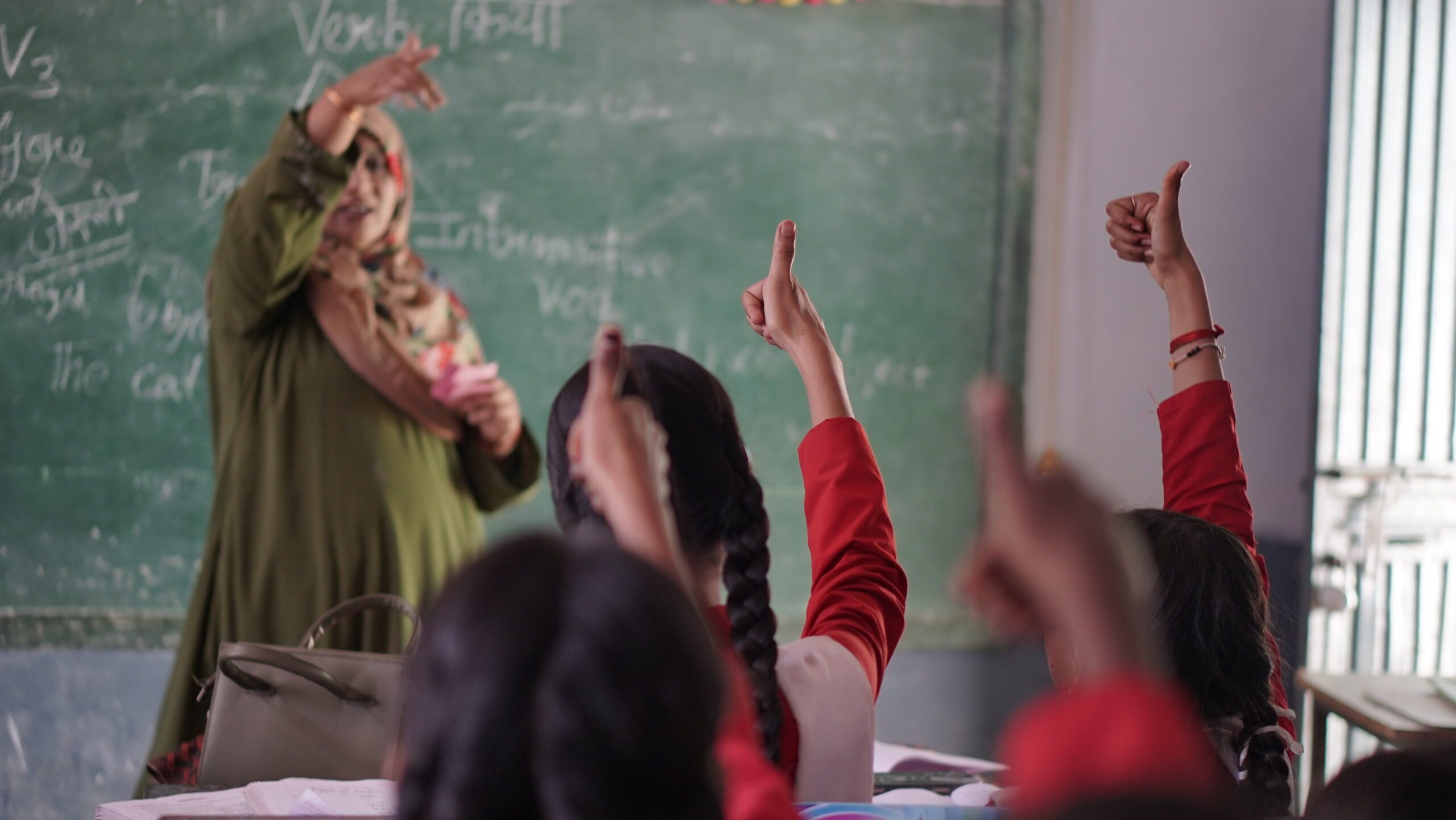
At an MCD school in Baljeet Nagar, Delhi, a teacher named Sonika manages two sections of Grade 3 combined into a single classroom of nearly 70 students, in a school without piped water. When Peepul’s team observed her class, all 70 students stayed engaged for the full 40-minute session, moving through a math talk, a guided activity, and individual practice, with struggling learners supported throughout.
What changed wasn’t the room or the resources. It was a set of small, deliberate teaching practices Sonika picked up through a Peepul numeracy workshop. Walk into two classrooms in the same school, same grade, same syllabus, and you can often tell within minutes which one is working. It is rarely about the worksheets on the desks. It is something quieter: how the room feels.
At Peepul, we train teachers across government schools in Delhi and Madhya Pradesh to build exactly this kind of high-engagement classroom. Here are five things we consistently see in the teaching practices of classrooms that work.
1. The room has a rhythm children can trust
Predictability is not the same as rigidity. The classrooms with the highest student engagement tend to have a clear shape: how the lesson opens, how transitions happen, how the day winds down.
One of the simplest tools we train teachers on is Tight Transitions: mapping a single, consistent route for moving between activities, lining up, or passing materials, so students execute it without extensive narration from the teacher. As one Peepul-trained teacher put it, “Now all the transitions have become quick and effective… they’re also helping students learn a sense of responsibility, being patient and sharing resources.” This is one of the simplest, most underused classroom management strategies available to a teacher, and it is something we train teachers to build deliberately rather than leave to instinct.
2. Teachers notice the difference between copying and learning
A child copying notes from the board looks like learning from the back of the room. It often is not.
We train teachers in effective teaching strategies like Cold Calling with Name Sticks, where a teacher draws student names at random to answer questions, rather than relying on volunteers. One Peepul-trained teacher described the shift: “My class has become more engaged and everyone participates because students know that I can ask a question to anyone… this technique also helps me in knowing whether my students have understood a particular concept or not.” Paired with Right is Right, where teachers insist on a complete, accurate answer before moving on, this kind of classroom engagement checks for real understanding, not just visible compliance.
3. Struggling is treated as information, not a verdict
A child who cannot yet solve a two-digit subtraction problem is not behind because they are slow. They are behind because they have not yet had the right number of attempts under the right conditions.
This framing matters enormously in classrooms where a large proportion of children are catching up on foundational gaps. Right is Right, used well, treats a partial answer not as a failure but as a starting point: teachers are trained to respond with phrases like “I like what you’ve done, can you get us the rest of the way?” rather than moving on or marking it wrong outright. Treating a wrong answer as data rather than a label is one of the clearest markers of a classroom built for active learning, not just classroom participation.
4. Mistakes get a second attempt, not a closed door
A student who struggled with a topic on Tuesday can still have a breakthrough on Thursday, but only in a classroom that allows for that.
We train teachers in Do It Again, where a task that falls short of the class’s standard is repeated immediately, while it is still fresh, with the focus kept on improvement rather than the mistake itself. As one teacher shared, “Do It Again also gives students another opportunity to understand their mistakes and rectify them.” That permission, quietly built into how a teacher responds, does more for student confidence in school than almost any single technique.
5. The teacher is actually present, not just instructing.
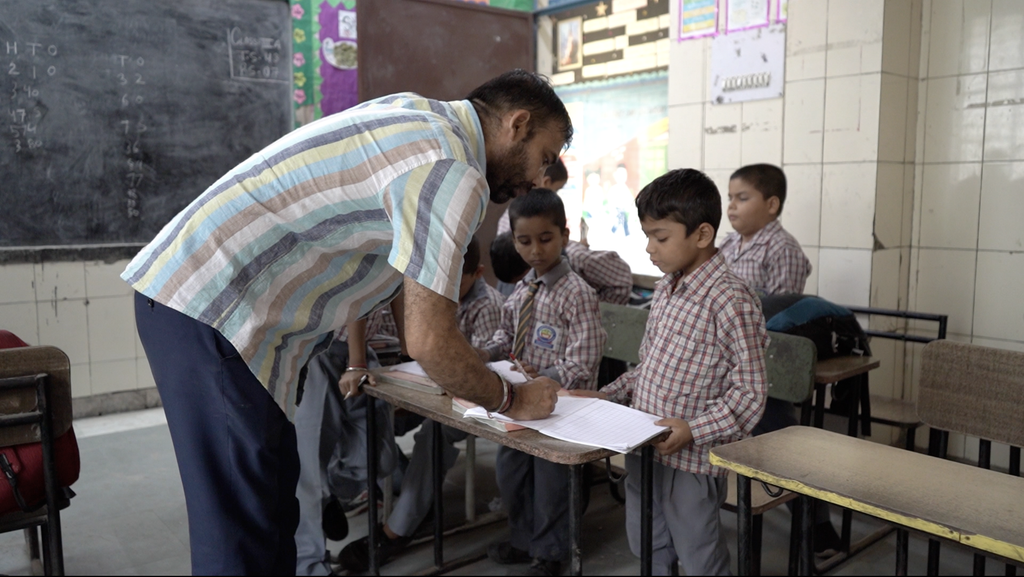
Genuine engagement in a classroom is hard to fake, and it starts with the adult in the room. Tools like STAR Position (Sit up, Track the speaker, Ask and answer questions, Respect those around you) give children a consistent way to show they are present and attentive, while freeing the teacher to notice who has quietly checked out.
This is the heart of what we mean by a high-engagement classroom: not a set of activities, but a teacher who is consistently, actively present with the children in front of them, the way Sonika was with all 70 of hers.
Building This at Scale
None of this depends on any single technique or one-off training session. At Peepul, our teacher professional development programmes and student teacher engagement programme work with teachers and students across government schools in Delhi and Madhya Pradesh to build these habits consistently, through ongoing mentoring, academic support, and workshops like the one that changed how Sonika ran her classroom- not a single session.
Children in government schools deserve classrooms built this way as a baseline, not an exception.
Donate for Education in India to help us bring high-engagement classrooms to more government schools.
FAQs
What makes a classroom “high-engagement” rather than just well-managed?
A well-managed classroom is quiet and orderly. A high-engagement classroom goes further: children are actively thinking, participating, and learning, not just behaving.
How does Peepul train teachers to build this kind of classroom?
Through ongoing, need-specific teacher professional development and academic mentoring, supported by practical classroom tools like Tight Transitions, Cold Calling, and Do It Again, rather than one-time workshops alone.
Does this approach help students who are behind grade level?
Yes. Treating gaps as something to work through with patience and repeated attempts, rather than as a fixed label, is core to how Peepul-trained teachers support children who are catching up on foundational skills.