Every year on April 23, the world pauses to celebrate books. But for the 120 million children attending government schools across India, there is rarely anything to pause over, because the shelf is simply not there.
The conversation around school infrastructure in India tends to fixate on toilets, classrooms, and mid-day meals, rightly so. But one piece of infrastructure goes almost unnoticed: the school library. A room of books. Or the absence of one. That absence, quiet and unremarkable, shapes whether a child learns to read fluently, think critically, or imagine a life different from the one they were born into.
What the Numbers Actually Tell Us About Reading Culture in Government Schools
ASER 2023, the Annual Status of Education Report, found that over 50% of Class 5 students in rural India cannot read a Class 2-level text. These are not children who lack intelligence. They are children who grew up in homes without books and schools without libraries.
The reading culture in government schools is not weak because children don’t want to read. It is weak because children have never been given a book to choose from. Choice is foundational to the love of reading. A child who picks a book, even a silly one about a talking crow, has already made a cognitive and emotional investment that a textbook cannot manufacture.
Print-Rich Classrooms- A Small Shift With Outsized Consequences
Research on early literacy consistently shows that print-rich classrooms, spaces where words, labels, charts, and books are visibly present, build early reading habits almost by accident. When a child walks past a word wall every morning, something registers. When a story corner exists in a classroom, children gravitate toward it during free time. The environment does the teaching before the teacher even speaks.
In most government primary schools, walls are bare or carry administrative notices. The message, unintentional but present, is that words are for record-keeping, not for imagination.
Foundational Literacy Development Cannot Wait for Later
The window for foundational literacy development is narrower than most education policy conversations acknowledge. By Grade 3, a child’s reading trajectory is largely set. The neural pathways that connect phonics to comprehension to fluency are built, or missed, between ages 4 and 9. A library that arrives in Grade 7 is better than nothing. But it arrives late.
“Children who read for pleasure, not duty, by age 10 consistently outperform their peers on nearly every academic metric by age 15.”
The operative word is pleasure. Textbooks are not a pleasure to read. They are structured, sequential, and tied to examination anxiety. A library offers something entirely different: self-directed exploration. A child in a government school who finds a book about dinosaurs, folk tales, or how planes fly is doing something quietly extraordinary. They are learning that knowledge is for them, not just for passing.
Why Student Learning Outcomes Depend On More Than Teaching Quality
Education reform conversations in India are, understandably, focused on teachers. Teacher development program, teacher attendance, teacher motivation: these matter enormously. But student learning outcomes are not produced by teachers alone. They are shaped by the ecosystem a child moves through for six to eight hours a day. A skilled teacher in a classroom with no books, no library, and no reading corner is working against the environment. The best pedagogical method cannot substitute for access to text.
Education Inequality in India Shows Up on Shelves, Not Just Scores
Walk into a private school in any mid-sized Indian city. There will be a library, often with a librarian, a catalogue, and quiet reading hours built into the timetable. Walk into a government school two kilometres away. The room labelled “library” might store sports equipment or double as a storage area for registers.
This is how education inequality in India reproduces itself. Not through dramatic exclusion, but through the quiet normalization of less. When government school children grow up never having browsed a shelf, chosen a book, renewed a library card, or lost themselves in a story, they are not just missing out on reading practice. They are missing out on the experience of being treated as intellectual beings with inner lives worth nurturing.
The Importance Of Books In Early Education Goes Beyond Literacy
The importance of books in early education extends well past decoding letters. Books build vocabulary at a rate that conversation alone cannot match. They expose children to syntax structures, emotional complexity, and contexts far outside their immediate geography. A child in a government school in Madhya Pradesh who reads a story set in a coastal fishing village has encountered a world. That encounter matters.
It also matters for identity. Seeing characters who look like you, speak like you, or live lives that resemble yours. That is not a luxury feature of good children’s literature. It is the difference between a child who reads and a child who does not see themselves in reading.
What Fixing This Actually Looks Like
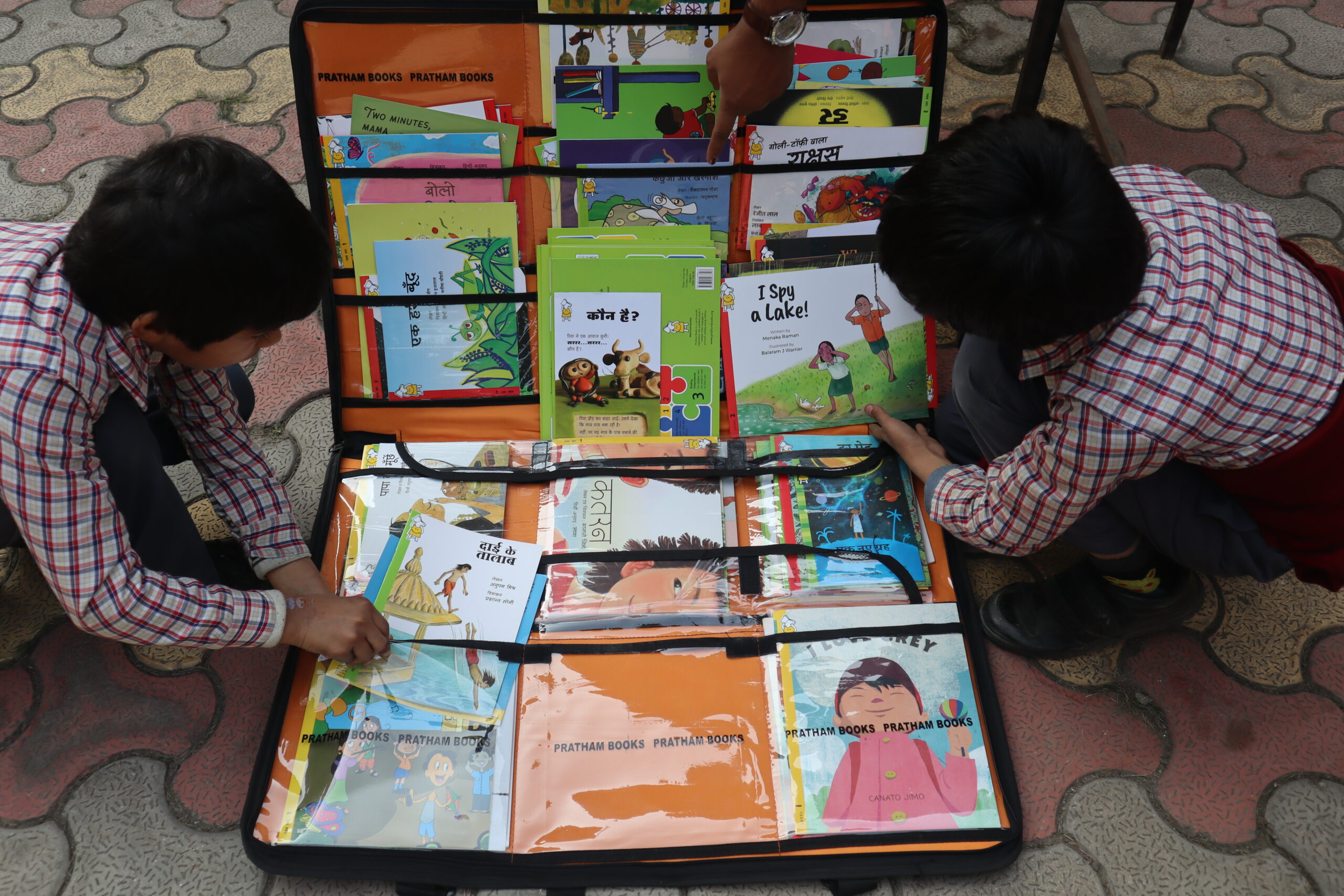
A functional school libraries does not require a separate room with polished shelves. It requires books, organization, and, critically, time. Time built into the school day when children can read without it being assessed. Reading corners in classrooms. Rotating book boxes across sections. Teacher read-alouds for children who are not yet independent readers.
At Peepul, the schools we work with in Delhi and Madhya Pradesh treat the classroom environment as pedagogy. A print-rich classroom is not decoration; it is infrastructure. When children are surrounded by text that is relevant, accessible, and at their level, literacy grows as a byproduct of simply being in school.
This April 23, on World Book and Copyright Day, the most honest thing we can say is this: India does not have a reading problem. It has an access problem. And access problems have solutions. If we decide they are worth solving.
Peepul works with government schools as an education NGO in India to build classrooms where every child, regardless of their family’s income or postcode, has access to a world of books.
If this matters to you, support learning for children in India.